The connected way
to manage job work
Track raw material, work in progress and finished goods across every job worker, from first cut to final delivery, on one connected ledger, one recipe, and compliance that is built in, not bolted on.
Free to start. No card required.
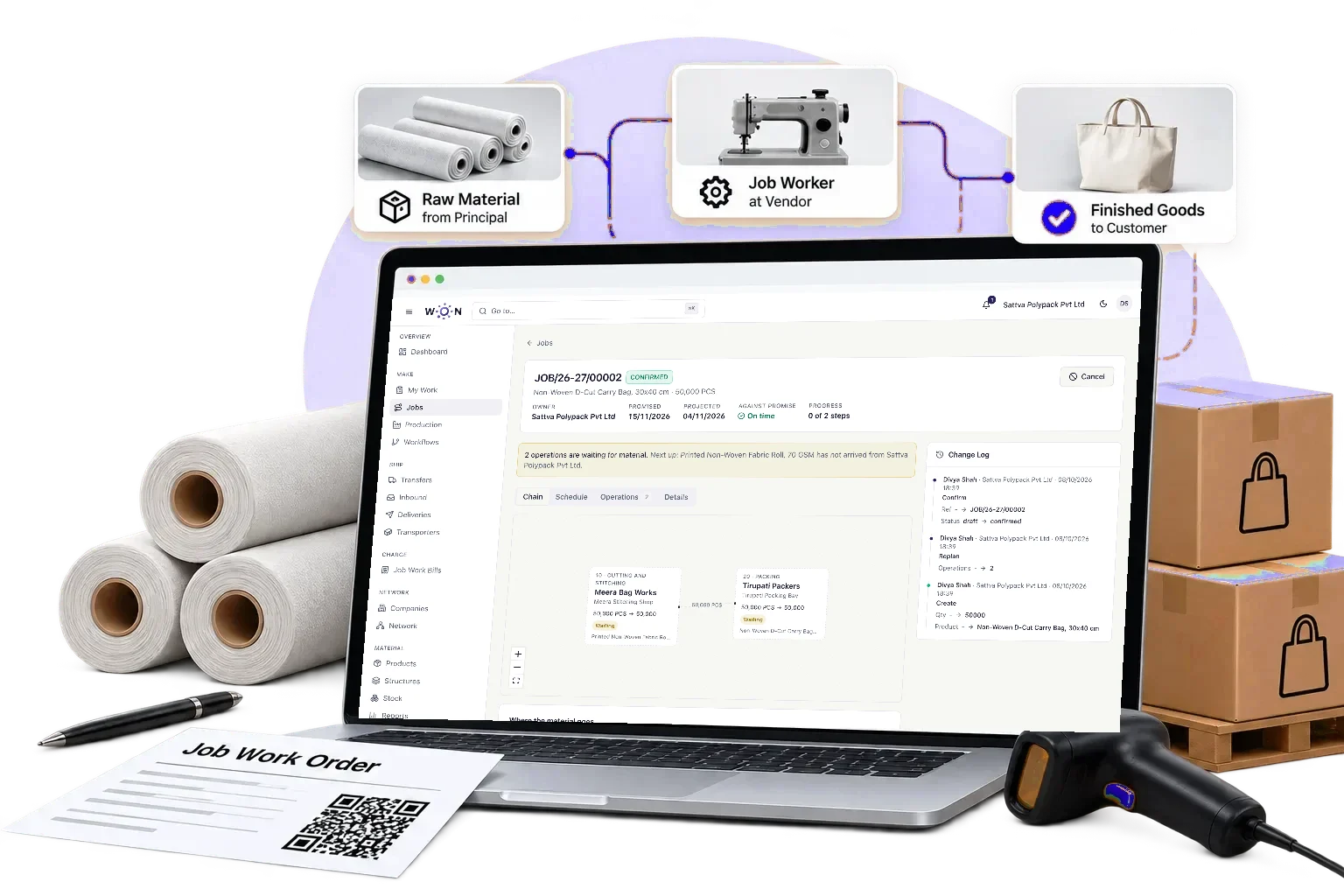
One challan, and the rest follows
Challans
Raised, approved and tracked on both sides, with the e-way bill checked before it moves.
Stock
Updates at both companies at once, so what is at each job worker is never a question.
Production
Runs against the recipe the principal defines, by lot, serial or quantity.
Compliance
The 180-day return clock and ITC-04 follow from the movements, not from a reminder.
The problem
Job work runs on phone calls. It should not.
Most job work chains are held together by registers, WhatsApp messages and memory. That works, until it does not, and the first time you notice is when the material does not add up.
One tonne of granules goes in at Company 1
Granules
Company 1
Fabric
Job Worker 1
59 kg trim
₹5,428
94.1% yield
Printed
Job Worker 2
46 kg waste
₹4,232
95.1% yield
34,600 bags
Job Worker 3
400 rejects
₹1,040
98.0% yield
₹10,700 left the chain on one tonne.
Each stage holds 94 to 98 percent, which reads as good. Three of them in a row is a tenth of the batch.
Yields measured from a live chain. Waste valued at the granule cost, the conservative end.
What changes
Everything a job work chain actually needs
Four operations run the whole business, each built around how job work happens on the floor rather than how a generic ERP imagines it.
Inventory transfers
Move material between job worker locations with challans and e-way bill checks handled automatically.
Manufacturing
Every stage runs against the recipe Company 1 defines, tracked by lot, serial or quantity.
Deliveries
Ship in partial batches, plan ahead, and let Company 1 decide the final route.
Internal returns
Rework, rejects and surplus move back up the chain, clearly separated from customer returns.
How it works
One chain, one source of truth
Follow a single batch of raw material as it becomes a finished product, across independently owned companies, each with their own login and their own view of the chain.
Company 1 sends Raw Material to Job Worker 1
A delivery challan is generated automatically, the e-way bill requirement is checked against value and distance, and Job Worker 1 is notified the material is in transit.
Job Worker 1 confirms what actually arrived
Received, short and damaged are recorded separately at the gate, so a discrepancy is a number on the challan rather than an argument three weeks later.
Job Worker 1 produces Semi-Finished Material 1
Job Worker 1 logs a production entry against Company 1's recipe, by lot, serial or quantity, and the ledger updates stock at that location while ownership stays with Company 1.
Material relays through Job Worker 2 and Job Worker 3
Each handoff repeats the same pattern: challan, compliance check, notification, receipt, with full traceability back to the original lot of Raw Material.
Company 1 routes the Finished Product
Once Job Worker 3 completes the Finished Product, Company 1 decides where it goes next: back to its own warehouse, or shipped straight to Company 1's customer.
The outcome
Nothing goes missing
Every unit of material is accounted for, at every stage, in one ledger that every company in the chain can trust, not a spreadsheet only one of them can see.
Nothing slips past a deadline
Return-clock alerts flag a compliance risk while there is still time to act on it, not after the deadline has passed.
Nobody has to ask
Job worker partners know exactly what to produce and when to ship, without a phone call to confirm it.
See it in action
Every location, one screen
Open WON and see the whole chain the way it actually moves: what is at each job worker right now, what happened to get it there, and what needs your attention next.
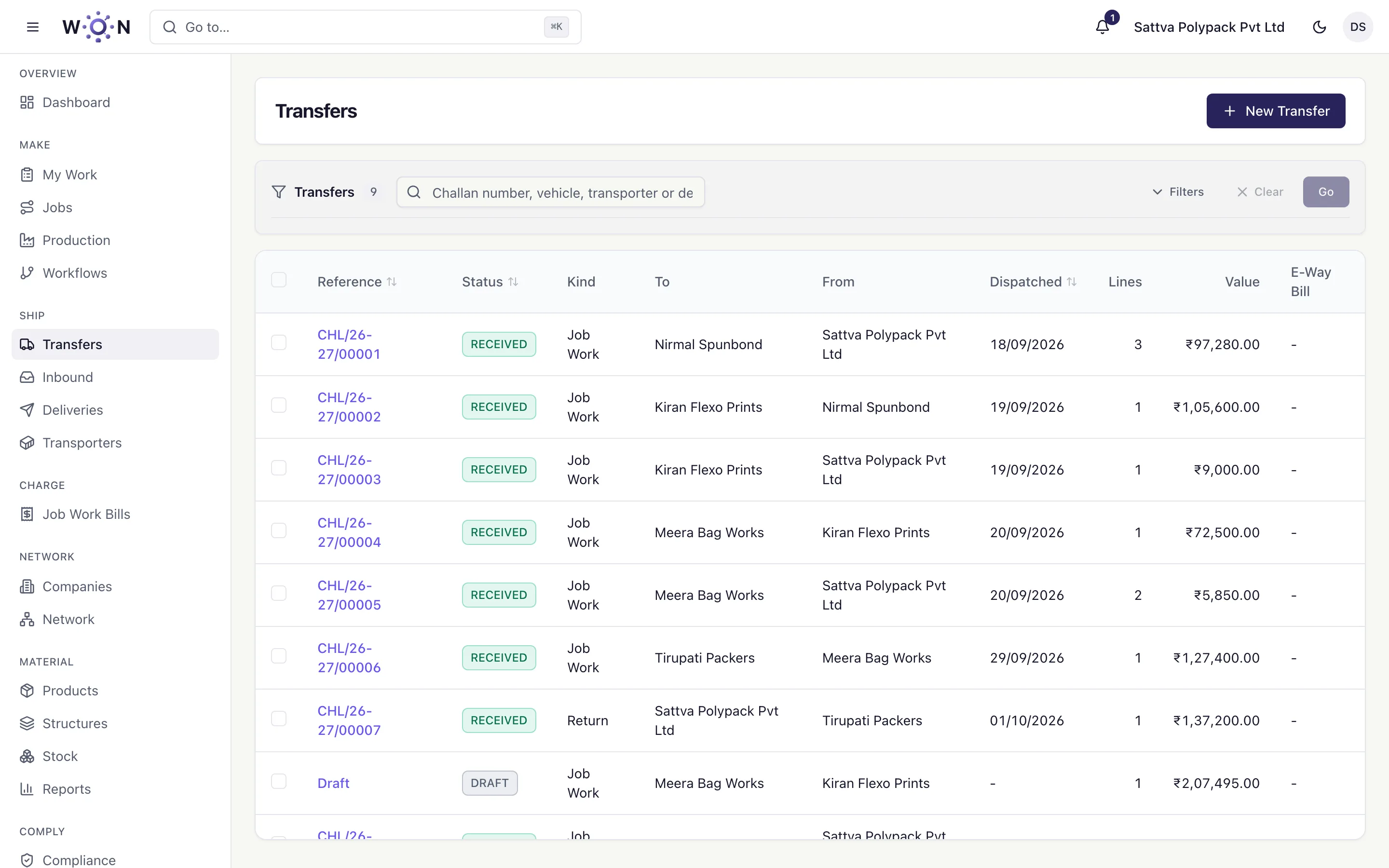
Every movement, with its paperwork attached
Nine challans between a principal and four job workers, each with who sent it, who has it now, what it is worth and whether an e-way bill was required.
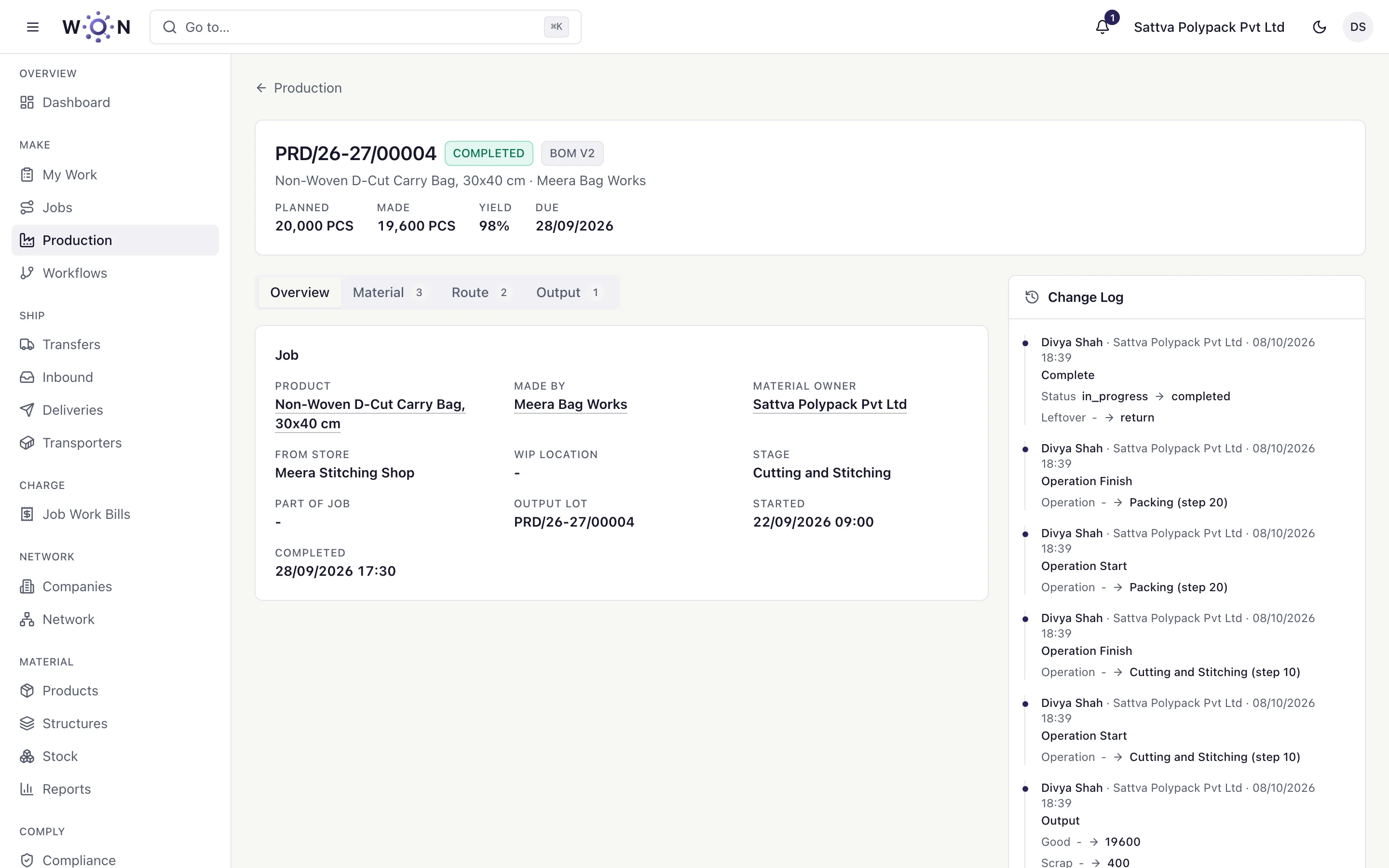
What was issued, what came out, what was lost
A production order pinned to one locked recipe version, with the good, rejected and scrapped quantities recorded separately rather than netted off.
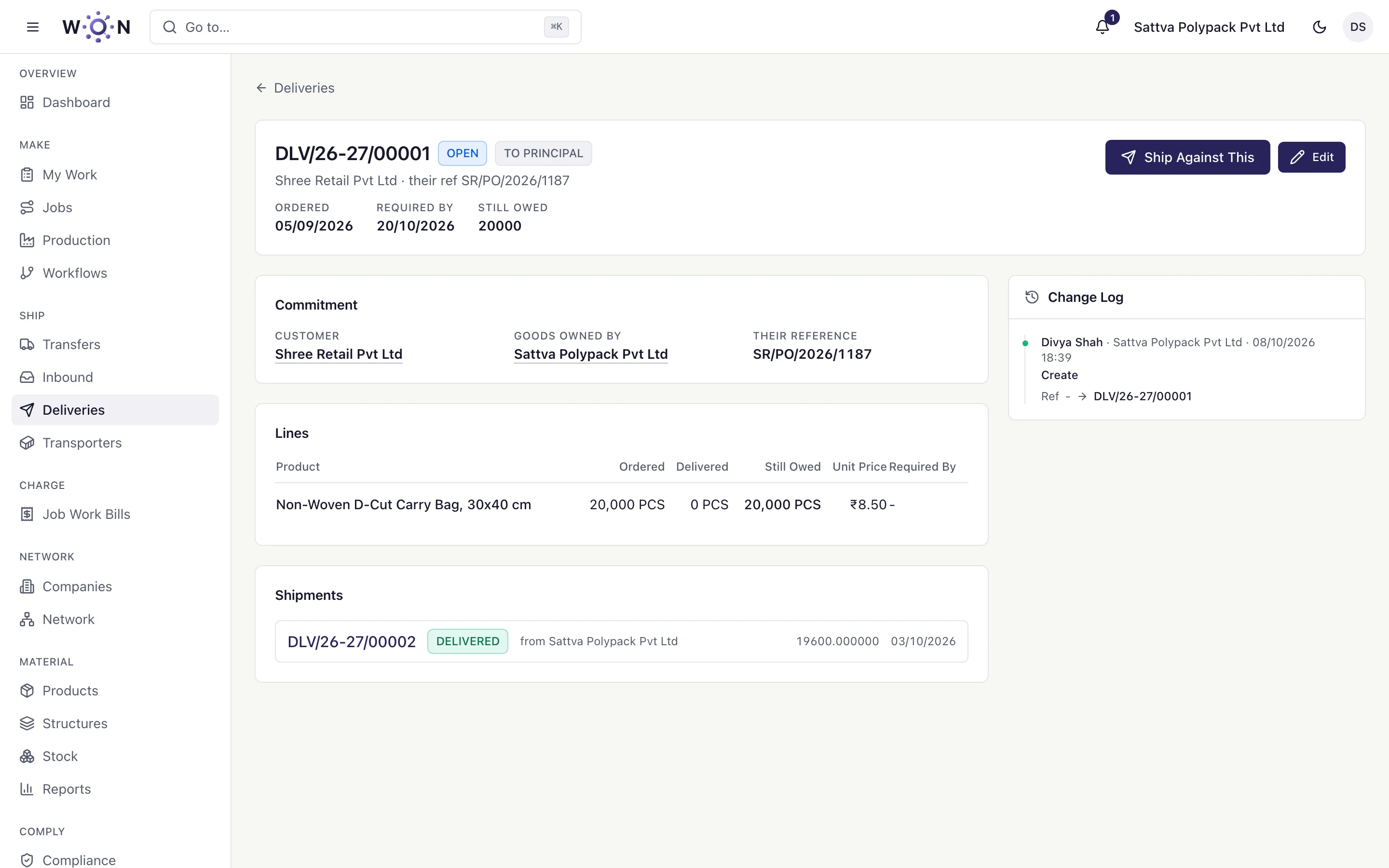
Finished goods, routed without re-keying
A delivery plan built from what the chain actually produced, so the despatch is made from the same record rather than typed again into a spreadsheet.
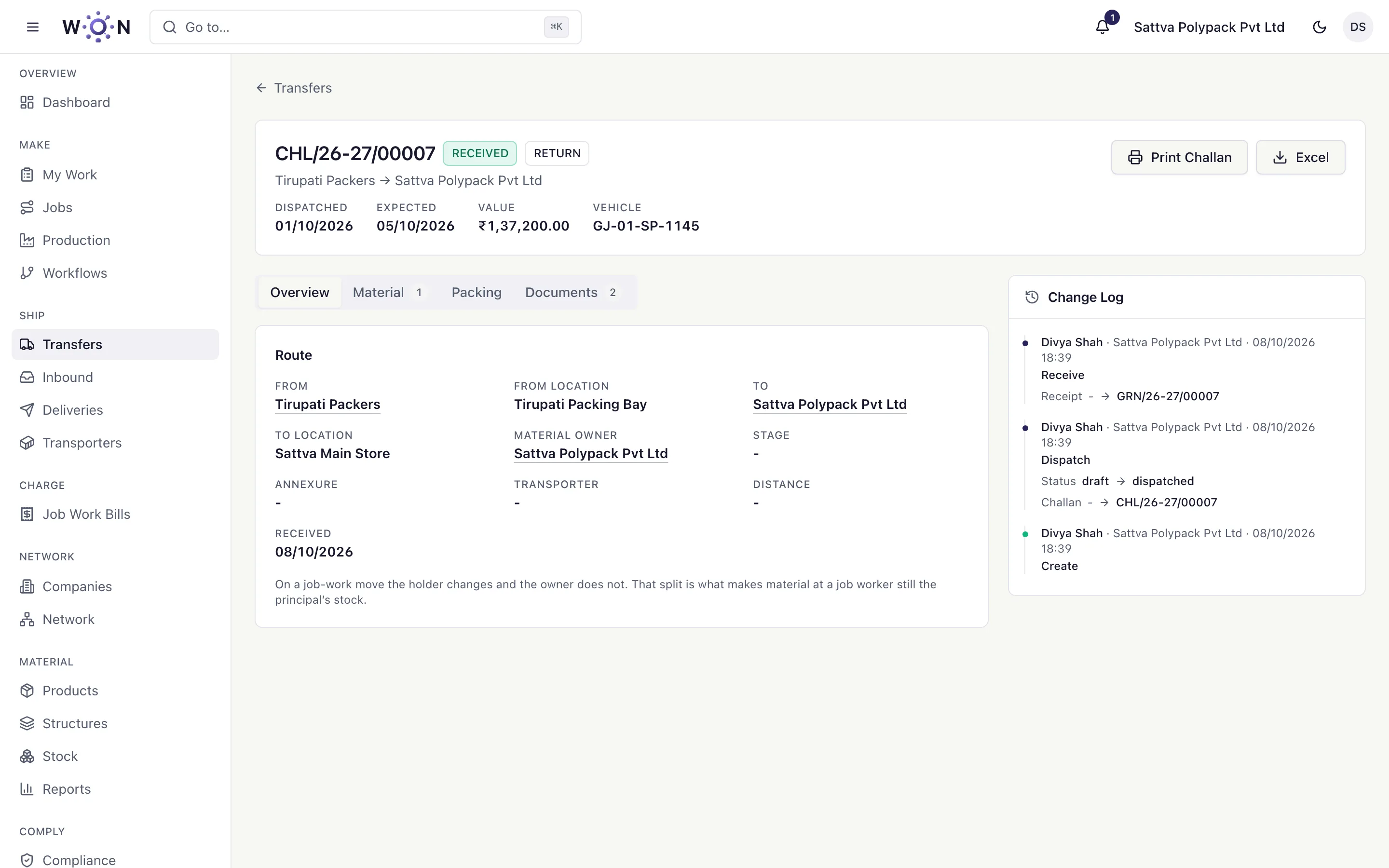
What came back, against what went out
A return challan from the last job worker, linked to the outward consignment it answers, so the return clock closes against the right movement.
Who it's for
Built for both sides of the chain
The principal who owns the material, and the job worker partners who process it. Each gets exactly the view they need, nothing more.

FOR THE PRINCIPAL, COMPANY 1
Run the whole chain from one screen
Define the recipe once, invite your job worker partners, and watch material move through every stage without a single WhatsApp status update.
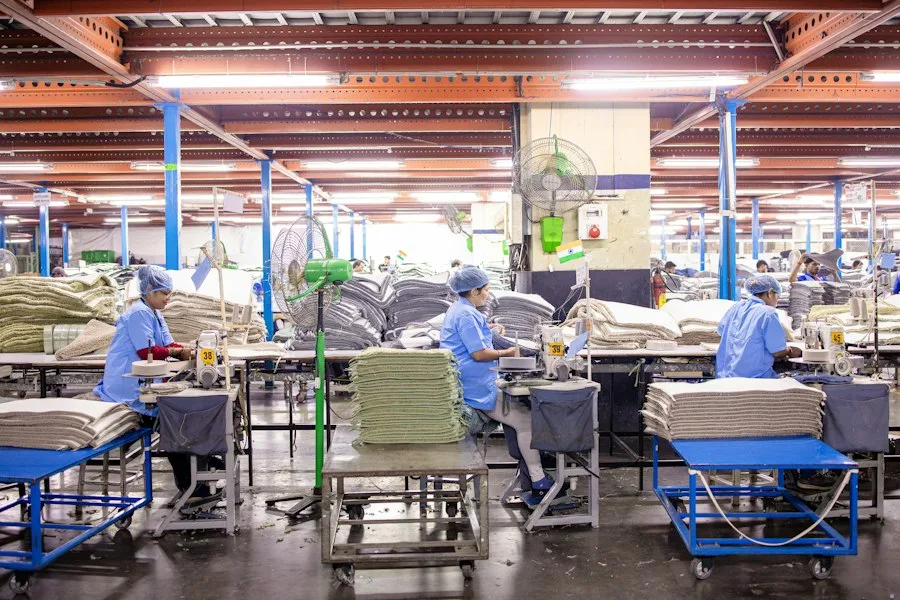
FOR THE JOB WORKER PARTNERS
Know exactly what is expected, every time
Receive material with the right paperwork already attached, produce against the correct recipe version, and dispatch without chasing anyone for approval.
Why it is different
Built for job work, not adapted to it
A generic ERP treats material at a subcontractor as stock that has left the building. In job work it has not: you still own it, and you are still accountable for it.
Today
Material handed to a job worker disappears from any system. It only exists in phone calls and paper registers.
With WON
One ledger shows exactly what material sits at which job worker, at every stage, at all times.
Today
Spreadsheets and chat threads are the source of truth, and both go out of date within a day.
With WON
WON replaces the spreadsheet and the chat thread as the single, live source of truth.
Today
No one can see how long material has been sitting at a job worker, until the GST return deadline is already at risk.
With WON
A return clock tracks every outward movement automatically and warns you well before a compliance deadline.
Today
Delivery challans and e-way bills are prepared by hand, which means errors, delays and rework.
With WON
Delivery challans and the e-way bill decision are generated automatically from every transfer.
Today
Every job worker seems to have a slightly different version of the same recipe, with no way to tell which one is current.
With WON
One version-locked recipe is shared with every job worker, so nobody produces off an outdated version.
Today
When material goes missing or arrives short, there is no record to settle the dispute.
With WON
Every movement is timestamped and logged, creating a full audit trail for any dispute.
Questions
Questions people actually ask
The ones that come up in nearly every conversation, answered without the sales gloss.
Do my job workers need to pay?
No. You pay for the workspace; the job workers you invite get their own logins at no cost. They see only the work they are doing for you.
Can I keep issuing challans from my existing system?
Yes. Every document can be recorded as an external reference: number, date, value and a scan. WON will not generate a duplicate.
What happens to material that does not come back in a year?
It becomes a deemed supply under Section 143, with interest. WON opens a clock on every outward challan line and warns you at eleven months, not afterwards.
Is this only for India?
Yes, and deliberately. Job work is an Indian statutory concept with its own rules, and WON implements them rather than approximating them: delivery challans under Rule 45, the Section 143 return clock, the CGST and SGST versus IGST split by place of supply, e-way bills and ITC-04. A product that tried to be right in three tax regimes at once would be properly right in none of them.
Can I import what I already have?
Yes. Products, bills of materials, packaging, opening stock, companies and locations all import from Excel, with a dry run that reports errors row by row before anything is written.
What if I want to leave?
Your data is yours. Export it whenever you like, and ask us to delete the workspace. We will, and confirm it in writing.
Get started
Ready to put your job work chain on one ledger?
Registration takes about two minutes. Your job worker partners can join right after, each with their own login and their own view of the chain.
Free to start. No card required.